My research seeks to elucidate the hydrological, chemical, and geologic processes that govern heat transfer and act to distribute chemical elements throughout the upper crust. I am particularly interested in the subsurface dynamics of vapor-liquid flow in magma-driven geothermal systems. In addition to direct measurement of the hydrologic and geochemical properties of real systems, the tools I employ include the Complex Systems Modeling Platform (CSMP++), and the GEMS and WATCH geochemical modeling packages.
The thermal structure and temporal evolution of geothermal systems
My research has shown primary geologic factors such as host rock permeability and intrusion depth control the depth and extent of boiling zones, the number and spatial configuration of upflow plumes, and how these aspects evolve over the systems' lifetime (published in Geothermics).
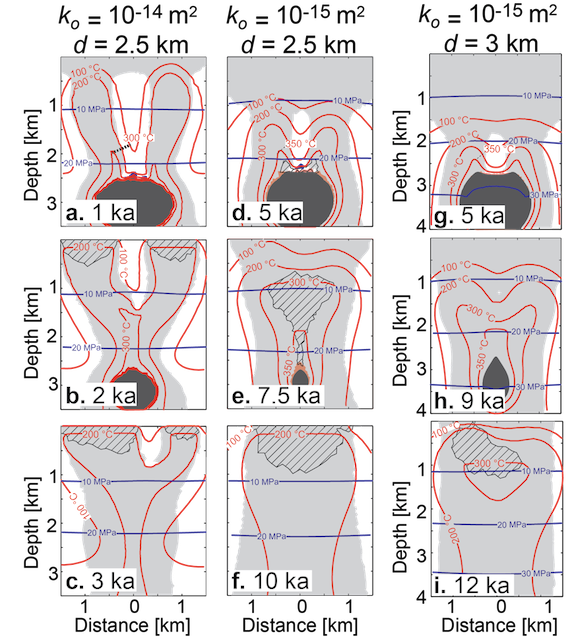
Figure: Effect of host rock permeability and intrusion emplacement depth on the transient development of geothermal systems and the depth of boiling zones (highlighted with diagonal lines). In a.-f., the emplacement depth is 2.5 km and host rock permeability is set to 10-14 m2 (a.-c.) or 10-15 m2 (d.-f.). In g.-i., the emplacement depth is 3 km and host rock permeability is set to 10-15 m2. The simulation time of the snapshot is shown in lower left. Isotherms and isobars are shown in red and blue, respectively. The light grey areas show the location of the upflow plume, defined as areas where the vertical component of the liquid pore velocity is positive. The dark grey areas show the intrusion, which is characterized by permeability ≤10-16 m2.
Host rock permeability is a primary control on the general structure, temperature distribution and extent of boiling zones, as systems with high permeability show shallow boiling zones restricted to ≤1 km depth, while intermediate permeability systems display vertically extensive boiling zones reaching from the surface to the intrusion. Intrusion emplacement depth is a further control, as intermediate permeability systems driven by an intrusion at ≥3 km depth only show boiling above 1 km. The development of multiple, spatially separated upflow plumes above a single intrusive body is characteristic of systems with high permeability and deep emplacement depth. Systems exhibit characteristic lateral and vertical gradients in pressure, temperature and enthalpy relative to the intrusive heat source, which may aid in geothermal exploration and interpretation of field measurements.
Supercritical water at the magma-hydrothermal interface
Ever since the Iceland Deep Drilling Project (IDDP) drilled into a 430 ℃ fluid reservoir above a 2 km deep magmatic intrusion at the Krafla geothermal system with the potential to generate roughly 35 MWe, there has been growing interest in tapping into supercritical geothermal resources to dramatically improve the efficiency and cost-effectiveness of power production from high-enthalpy geothermal systems. Numerical models of pure water flow above magmatic intrusions show how primary geologic factors influence of the temperature and spatial extent of supercritical geothermal resources (published in Nature Communcations).
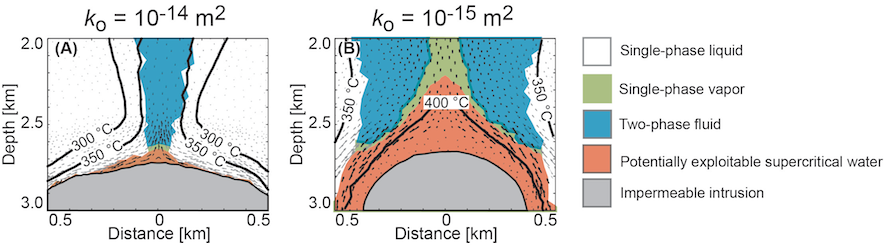
Figure: Supercritical geothermal resource formation depends on host rock permeability. Fluid phase state distribution shown with colors (see legend) and temperature distribution shown with black lines. Snapshots under different conditions of host rock permeability (ko) with a brittle-ductile transition temperature of 450 ℃. We vary ko from (A) 10-14 m2 to (B) 10-15 m2.
If the rock surrounding an intrusion is highly permeable (A), supercritical resources will be close to the intrusion, relatively limited in spatial extent, and at temperatures near 400 ℃. If the rock surrounding the intrusion is moderately permeable (B), the reservoirs will be larger and at higher temperatures. However, the fluid production rate for a well drilled into a supercritical reservoir will be higher when rock permeability is higher. Thus, there is a trade-off between fluid temperature and well productivity that is governed primarily by rock permeability. Furthermore, the models reproduce measured data from the IDDP-1 well when the geologic controls are set to appropriate values for the Krafla system. In contrast to previous thoughts that fluid pressures in excess of the critical pressure of pure water are necessary for supercritical resource formation, the models show high enthalpy of water at supercritical temperatures and subcritical pressures actually promotes the development of economically attractive resources above shallow intrusions. Moreover, the models show how conventional geothermal resources result simply from the mixing of supercritical fluids ascending from the intrusion and cooler fluids circulating near the intrusion but not heated to supercritical conditions. These are new ways to look at conventional and supercritical high-enthalpy geothermal reservoirs.
The liquid and gas geochemistry of active systems
Based on samples of vapor and liquid obtained from two-phase well discharges in the Hellisheiði geothermal system, deep aquifer fluid chemical compositions were reconstructed and used to update the conceptual model of the system (published in Geochimica et Cosmochimica Acta). The study emphasized how phase segregation effects could be taken into consideration when modeling the aquifer fluid compositions of excess-enthalpy wells, which discharge much more vapor than would result from closed-system boiling of the initial aquifer fluid.
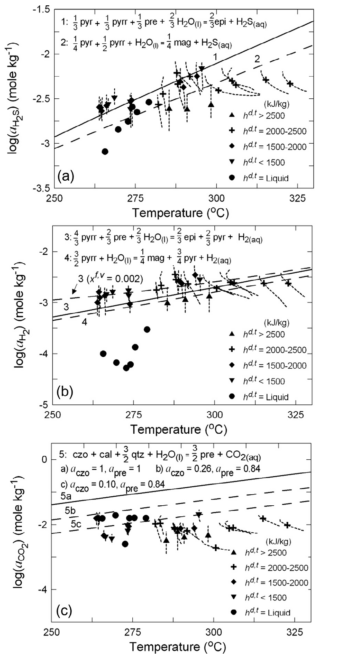
Figure: Comparison of calculated concentrations of H2S, H2 and CO2 in aquifer fluids of the Hellisheidi system with predicted concentrations assuming equilibrium with alteration mineral buffers. Dotted lines show the total range of variability due to assumed phase segregation conditions.
The calculated concentrations of volatile species in the aquifer fluid are very sensitive to the assumed phase segregation conditions while non-volatiles are not greatly affected by this model parameter. However, the concentrations of reactive compounds closely approach to fluid–mineral equilibrium at aquifer temperatures above 250 ℃. The CO2 concentrations are below equilibrium with respect to the likely mineral buffers, which suggests a possible source control. Elevated H2 concentrations indicate a small equilibrium vapor fraction in aquifer fluids (≤0.2% by mass or ≤3% by volume). Based on the spatial distribution of volatiles and chloride, an updated conceptual model is proposed with multiple upflow zones as opposed to a central upflow zone below the Hengill central volcano.
Fluid phase separation in the deep parts of saline geothermal systems
Several active high-enthalpy geothermal systems, such as Reykjanes in Iceland or Salton Sea in California, feature geothermal waters containing significant concentrations of dissolved salt. Saline water phase relations, approximated by the system H2O-NaCl, differ significantly from those of pure water, and liquid-vapor coexistence can extend to temperatures and pressures far above the critical values of pure water. Numerical simulations of subaerial, magma-driven, saline hydrothermal systems (recently published in Geophysical Research Letters) reveals that fluid phase separation near the intrusion is a first order control on the dynamics and efficiency of heat and mass transfer.
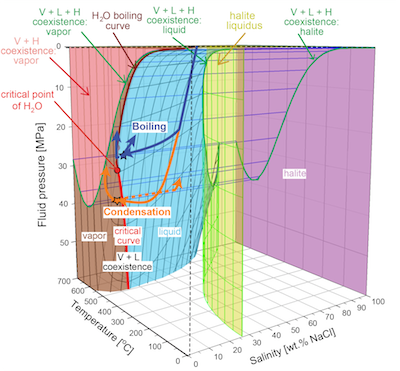
Figure: Phase diagram of the system H2O-NaCl illustrating the effect of intrusion depth on the style of phase separation of an initial seawater-salinity fluid. The blue path represents the circulation from the surface to ~2.5km depth, followed by upflow and boiling, while the orange path represents the circulation to ~4.5km depth, followed by upflow and condensation.
Above shallow intrusions emplaced at 2.5 km depth, phase separation through boiling of saline liquid leads to accumulation of low-mobility hypersaline brines and halite precipitation, thereby reducing the efficiency of heat and mass transfer. Above deeper intrusions (>4 km), where fluid pressure is >30 MPa, phase separation occurs by condensation of hypersaline brine from a saline intermediate-density fluid. The fraction of brine remains small, and advective, vapor-dominated mass and heat fluxes are maximized. We thus hypothesize that, in contrast to pure water systems, for which shallow intrusions make better targets for supercritical resource exploitation, the optimal targets in saline systems are located above deeper intrusions.